// custom ERP

Custom cloud ERP built for your company

DevTeam builds custom ERP systems: web applications that bring orders, stock, purchasing, invoicing and shipping into one system, designed around the way your company works. Our work includes the production ERP for Sanprod and the orders, invoicing and shipping platform for D&G Group. We have been building custom software in Bucharest, Romania, since 2015.

2015
the year we started building custom software in Bucharest
4
ERP and operations platforms delivered, shown below
6,200+
orders processed through the D&G Group platform by November 2024
13,000+
products in the D&G Group catalogue, synced from Neosys
// modules

What your ERP can include

A custom ERP has exactly the modules your company needs, for procurement, production, sales, accounting, projects and distribution. Start with the essentials and add the rest in stages. We have already built most of these modules in delivered projects.

Orders and quotes

Quote requests turn into orders, with the customer, products, price and status of each. Anyone on the team can see where an order stands.

Example: quote requests in the Sanprod ERP, quoted, confirmed or in progress.

Stock and materials

Stock for every product or material, with its movement history, consumption per order and totals for any period.

Example: at Sanprod, material stock in kilograms and consumption on every order.

Purchasing and procurement

Suppliers, purchase orders and goods received, linked to stock, so you reorder in time and know what is on its way.

Production and machines

Orders are assigned to machines and workers, with the estimated setup and processing time for each product.

Example: the Android app used at the Sanprod machines.

Invoicing and accounting

Invoices linked to orders, with series, due date and cancellation, plus a connection to your accounting or inventory software.

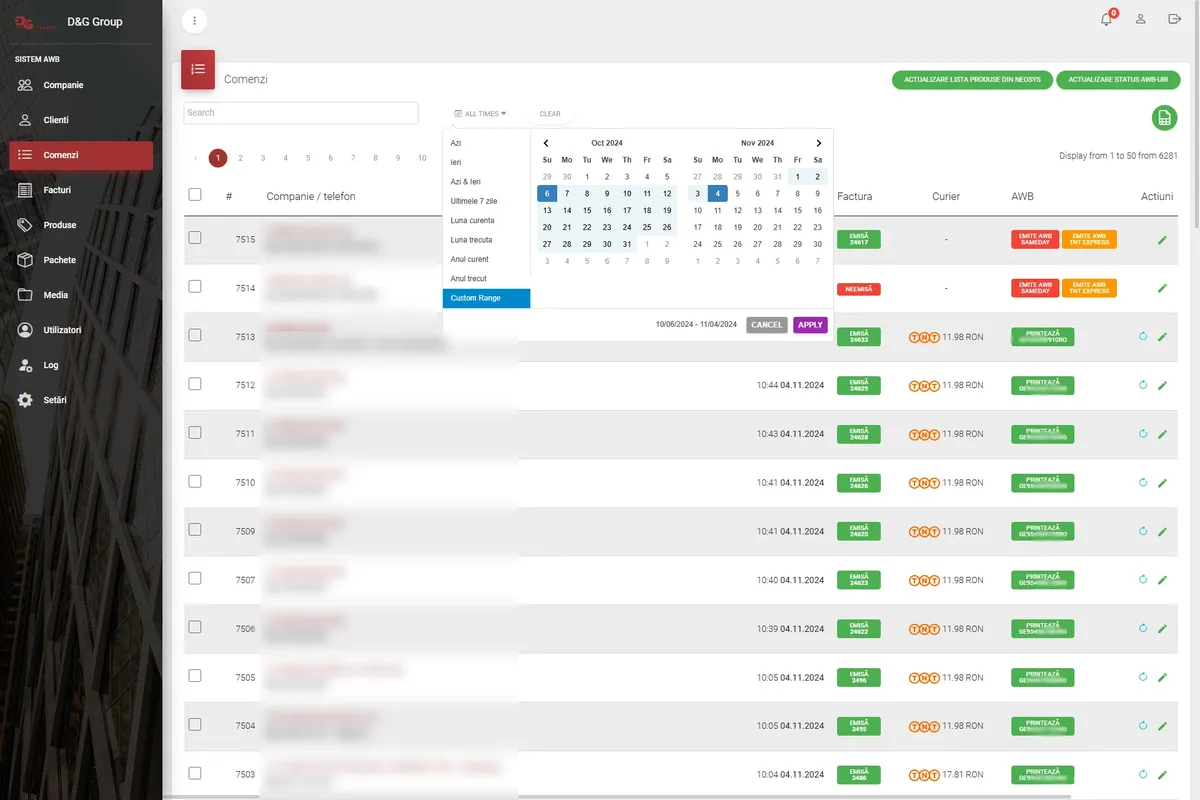
Example: invoices linked to orders at D&G Group.

Shipping and distribution

Shipping labels are issued from the order with the chosen courier, and the delivery status is updated in the app.

Example: Sameday and TNT Express labels issued from the order at D&G Group.

Documents from templates

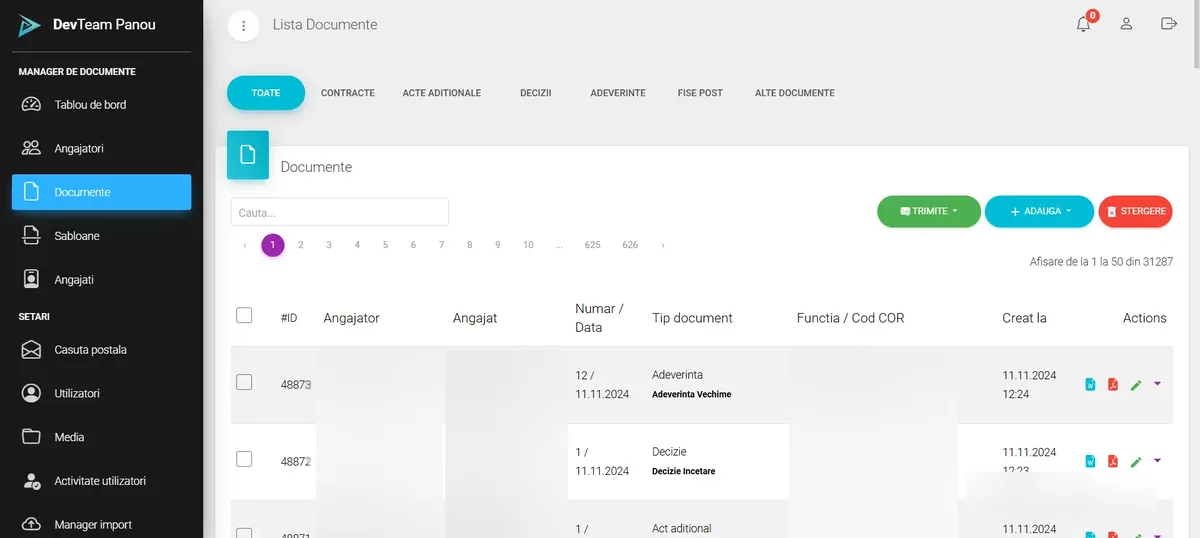
Contracts, decisions, certificates and other documents generated from templates, with the data already filled in, downloaded as Word or PDF.

Example: the HR documents in DMS.

Reports, roles and audit log

A real-time dashboard, reports exported to Excel, roles for every user and a log of every action.

Example: more than 18,700 entries in the D&G Group activity log.

// portfolio

ERP and operations platforms we have delivered

Four projects from our portfolio, in different industries: manufacturing, medical equipment distribution, HR documents and logistics. The details are in the case studies.

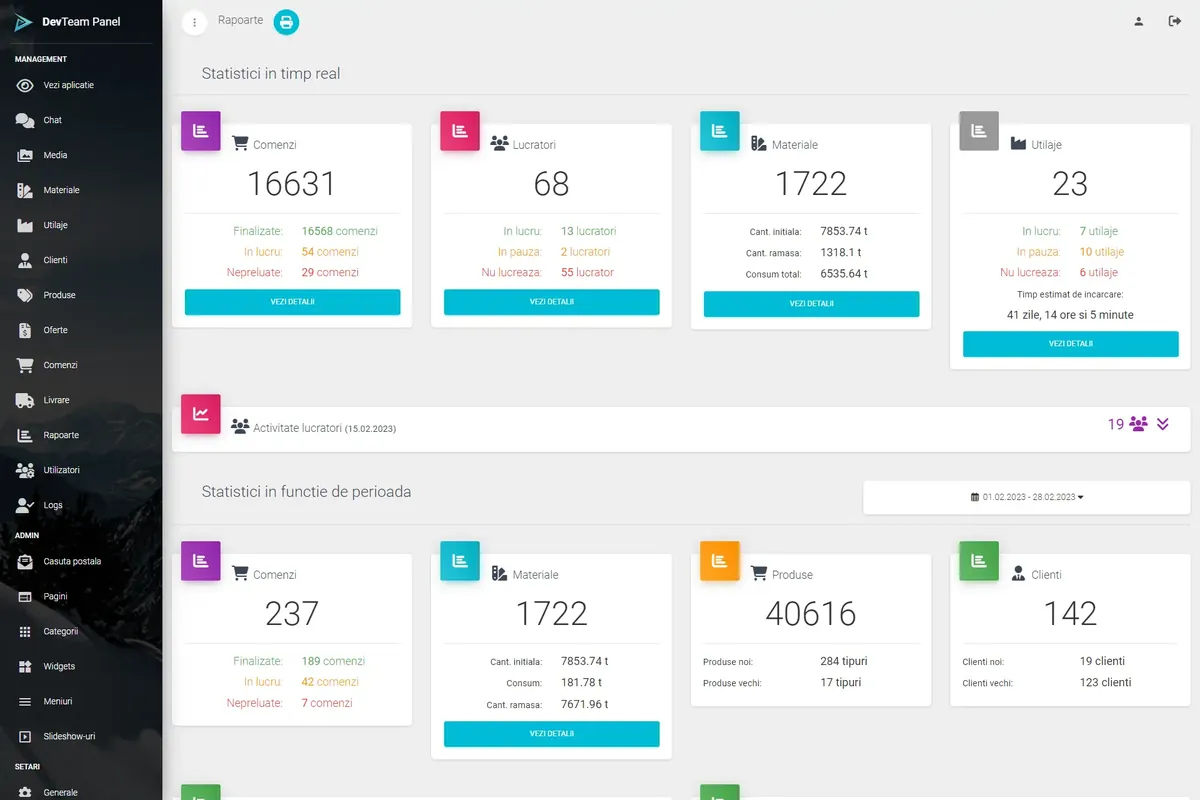
The Sanprod ERP dashboard, with real-time statistics for orders, workers, materials and machines
// production ERP · metal profiles

Sanprod: a production ERP, from order to machine

An ERP built for Sanprod Romania, a manufacturer of metal profiles: a web dashboard for the office, an Android app used at the machines and a REST API that keeps them in sync.

  • Quote requests and orders with materials, weight, total price and estimated time
  • Orders assigned to machines, in an Android app with PIN login
  • Materials with stock in kilograms, linked to the Nexus inventory software
  • Real-time dashboard, worker activity and reports exported to Excel
Read the Sanprod case study
// how to choose

Custom ERP or off-the-shelf ERP?

Not every company needs an ERP built from scratch. These are the differences that matter when you choose between a custom ERP and an off-the-shelf one, on a subscription or a licence.

Comparison between an off-the-shelf ERP and a custom ERP
Criterion Off-the-shelf ERP (subscription or licence) Custom ERP
Processes Your company adapts to the workflows, fields and documents of the software. The software follows your workflows: orders, approvals, production, shipping.
Getting started You sign up or buy a licence, then configure the software. After analysis and development, usually 3–4 months. You can start with the essential modules and add the rest in stages.
Cost A subscription or licences per user, which grow with your team and your modules. Development, from €9,000 + VAT, then hosting and maintenance, agreed in the contract.
Integrations The ones the product offers, or through connectors. Built for your software: inventory, accounting, couriers, marketplaces.
Your data On the vendor's servers. On your own server or in the cloud you choose.
New features When the vendor adds them, for all its customers. When you need them, in the order of your priorities.

A custom ERP makes sense if:

  • your processes (production, orders, shipping) do not fit an off-the-shelf ERP without many compromises;
  • you use several systems (inventory, accounting, couriers) and copy data between them by hand;
  • people on the shop floor, in the warehouse or in the field need simple screens made for their work;
  • you pay licences for many users and for modules you only partly use;
  • you want your company data on your own server or in the cloud you choose.
// starting smaller

Mostly need customers and sales? Start with a CRM

If you have no stock, production or shipping to track, a custom CRM may be enough: customers, opportunities, activities, roles and reports. It starts at €6,000 + VAT and usually takes 2–3 months.

Custom CRM development
// integrations

Integrations and data migration

An ERP pays off when data flows into it on its own, with no copying between systems. These are integrations we have built in delivered projects.

  • Inventory software: Neosys, Nexus
  • Accounting: export to Saga
  • Couriers: Sameday, TNT Express
  • eMAG Marketplace
  • ANAF RO e-Factura (e-invoicing)
  • ANAF RO e-Transport
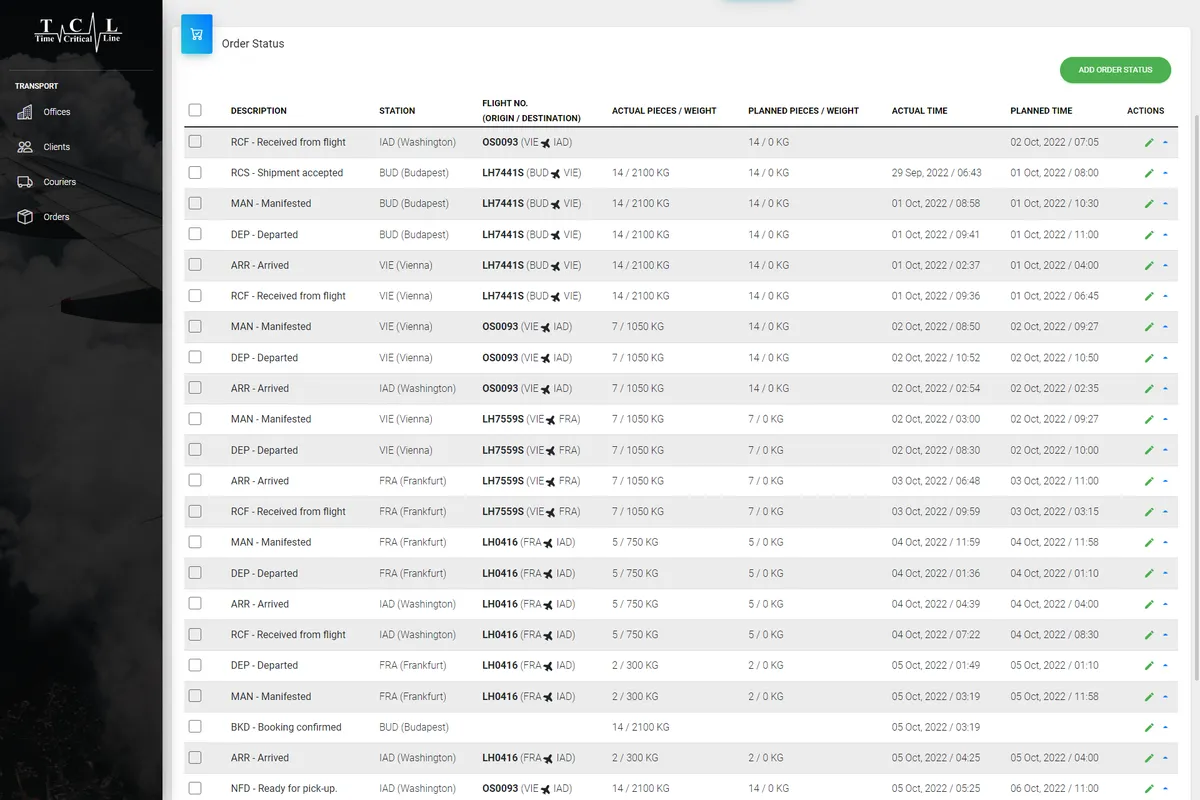
  • Lufthansa Cargo, Qatar Airways Cargo APIs
  • SMS notifications
  • Android app
  • Data import and export
  • REST API

At D&G Group, the product catalogue is updated from Neosys and shipping labels are issued from the order. At Sanprod, differences from the Nexus imports show up in each material's history. For Zenda, invoices are exported to the Saga accounting software, and products, orders and stock are synchronised with eMAG Marketplace. For companies in Romania, invoices go to RO e-Factura and shipments to RO e-Transport through the ANAF APIs, as at Time Critical Line and Data Control; we are also the technology partner of eFacturia. We also move your existing data from Excel or your old system. For any other software or API, we check the documentation and the integration effort during the analysis.

ERP with artificial intelligence

Invoices, contracts, delivery notes and forms read automatically from PDFs, scans or images: the AI extracts and validates the data and sends it to your ERP, with no retyping.

AI document automation
// process

How we build an ERP

We start from the way your company works, not from a template. We build in stages, with demos along the way, so you see the ERP take shape and can change direction early. With international clients, specifications, demos and day-to-day communication are in English.

  1. 01

    Process analysis

    We talk to the people in each department (sales, purchasing, production, warehouse, accounting) and define the modules, the users and the systems the ERP has to work with.

  2. 02

    Estimate and quote

    You get a cost and time estimate, per module. The quote is free.

  3. 03

    Design

    Wireframes and design for the main screens (the order, the stock, the dashboard), approved by you.

  4. 04

    Development in stages, with demos

    We build the ERP module by module and show it to you along the way, not only at the end.

  5. 05

    Data migration and testing

    We import your existing products, customers and stock and test the workflows, roles and integrations before launch.

  6. 06

    Launch and training

    We put the ERP into production and train every team that will use it.

  7. 07

    Maintenance and new modules

    Support, updates and new modules as your company grows. We have been developing and maintaining the Time Critical Line platform, for example, since 2020.

// budget and timeline

How much a custom ERP costs and how long it takes

A custom ERP starts at €9,000 + VAT and usually takes 3–4 months. At this price you get the core modules: orders, stock, purchasing, invoicing, users with roles and reports, in a single platform built around your processes. We estimate the final price per module, once we understand how you work. These are the factors that matter most.

Additional modules

Production, projects, distribution or documents, on top of the core modules.

Users and roles

How many types of users you have, from the office to the warehouse, and what each one sees or approves.

Integrations

Your inventory or accounting software, couriers, marketplaces and third-party APIs.

Existing data

Importing products, customers and stock from Excel or from your old system.

Shop floor or field app

Screens for the warehouse or production, or an Android app, as at Sanprod.

Maintenance

Support, updates and new modules after launch.

The timeline depends on the same factors. We can start with the essential modules (orders, stock, invoicing) and add the rest in stages, while your team already works in the ERP. Starting prices for other types of projects are in our guide How much custom software development costs.

The quote is free

After a first call, we send you a cost and time estimate. To make it as accurate as possible, tell us:

  • which processes you want in the ERP: orders, stock, production, shipping, invoicing;
  • how many people will use it and in which roles;
  • which systems you use today (inventory, accounting, couriers) and where your data lives.
Get an estimate
// FAQ

Frequently asked questions about custom ERP

An ERP (Enterprise Resource Planning system) is the software a company uses to run its day-to-day operations in one place: procurement, stock, production, sales, accounting, projects and distribution. What one department enters is immediately visible to the others, with no copying between systems.

A cloud ERP is a web application: you use it in the browser, from the office, the warehouse or home, with nothing to install on each computer. Hosted in the cloud, it needs no servers on your premises. The ERPs we build are web applications, and we choose the hosting together, based on data volume and budget: your own server, a dedicated server or a cloud provider.

A custom ERP starts at €9,000 + VAT for the core modules: orders, stock, purchasing, invoicing, users with roles and reports. The final price depends on additional modules such as production, projects or distribution, on integrations and on the data that needs to be migrated. The quote is free.

An ERP with the core modules usually takes 3–4 months. Beyond that, it depends on the number of modules, the integrations and the data to migrate. The quote includes a time estimate per module. We can launch the essential modules first, so your team works in the ERP while we build the rest.

Yes. We have connected platforms to Neosys (the D&G Group product catalogue), to Nexus (the materials in the Sanprod ERP) and to Saga (the invoice export for Zenda). For any other software, we check during the analysis what it allows (an API, file import or export) and how much work it takes.

Yes. Importing your existing data is part of the project: products, customers, stock and history, once we agree on what to keep and how the fields map. In DMS, for example, data is imported per company, and every import stays in the list, with its company and date.

Yes. The ERP is a web application that adapts to the screen, so it works on computers, tablets and phones. For production or the warehouse we can also build a dedicated app: at Sanprod, workers log in with a PIN to an Android app, see the orders for each machine and update their status. See also mobile app development.

The rights to the source code and access to it are agreed in the contract, before development starts. We choose the hosting together, based on data volume and budget: your own server, a dedicated server or a cloud provider. Access to the data is set by role, and the activity log shows who changed what, and when.

Yes. Romania is an EU member state, and Bucharest is one hour ahead of Central European Time, so our working day overlaps fully with Central and Western Europe. With international clients, specifications, demos and day-to-day communication are in English, and EU data protection rules apply to our work from the start.

We can review the application: the code, the infrastructure and the documentation. We tell you what can be continued, what should be rebuilt and how much work it takes, then we decide together how to move forward.

Yes, for companies operating in Romania. The invoice is issued in the ERP from the order data and reaches the ANAF SPV through the ANAF eFactura API, with the company's digital certificate; shipments can also be declared in RO e-Transport. We built this at Time Critical Line and Data Control, and we are the technology partner of eFacturia, an online invoicing software with RO e-Factura.

// technologies

What software technologies do we use?

Our main technology for web projects is Laravel, a PHP framework with elegant syntax that scales easily and offers excellent security.

Laravel doesn't stop us from working with .NET, Java, Swift or other technologies when a project calls for it. We prefer it for the web because it lets us deliver similar projects faster, at a lower development cost.

  • Artificial intelligence
  • Deep Learning
  • TensorFlow
  • .NET Framework
  • .NET Core
  • Java EE
  • Python
  • PHP
  • main Laravel
  • React
  • Vue.js
  • Bootstrap
  • REST API
  • Android
  • iOS
  • Swift
  • Jira
  • Git
  • GitHub
  • Bitbucket
  • SQL Server
  • MySQL
  • MariaDB
  • MongoDB
// next step

Do you have a project you want to develop?

Write to us or give us a call and we will set up a meeting. We reply with questions first, then with a free quote that covers cost and timeline.

Or email us at contact@devteam.ro.