// freight forwarding, transport and courier

Custom logistics and transport software

We build custom web platforms and ERP systems for freight forwarders, IATA cargo agents, carriers and courier companies: quotes, orders, documents, invoices and shipment tracking, in one admin panel. Since 2020 we have been developing the Time Critical Line platform, which receives flight statuses through the Lufthansa API, and in the D&G Group platform, Sameday and TNT Express AWBs are issued straight from the order.

2015
the year we started building custom software, in Bucharest, Romania
2020
since then we have developed and maintained the Time Critical Line logistics platform
6,200+
orders managed in the D&G Group platform by November 2024
13,000+
products synced from the Neosys inventory software at D&G Group
// modules

What your logistics platform can include

Custom logistics software follows the path a shipment takes through your company, from the quote request to delivery and invoicing. You pick only the modules your team needs. The examples come from delivered projects.

Orders and quotes

Each order holds the AWB, the shipper, addresses and contact persons. The quote is generated from the order in one click and sent to the customer automatically.

Example: quoting at Time Critical Line.

Shipment tracking

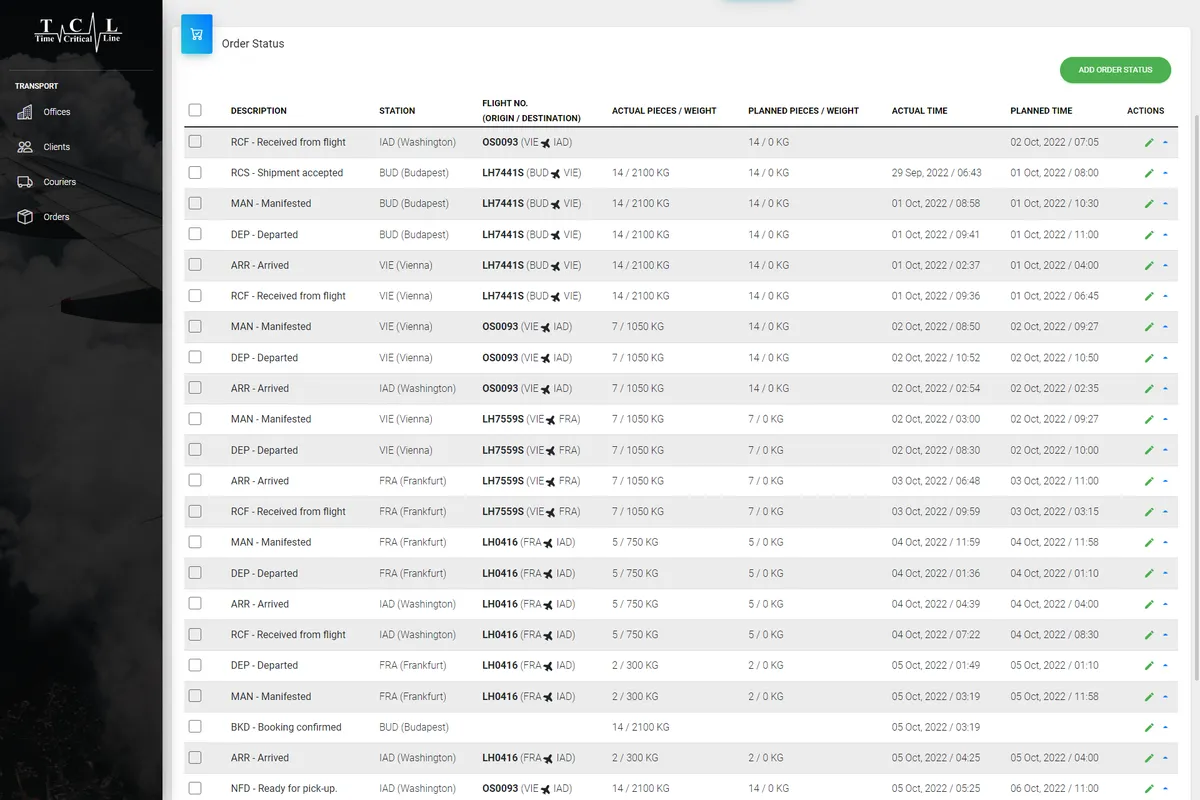
Statuses for every shipment, leg by leg: flight, airport, planned and actual times, pieces and weights. The team sees at once whether a shipment is on plan.

Example: flight statuses at Time Critical Line.

Courier AWBs and labels

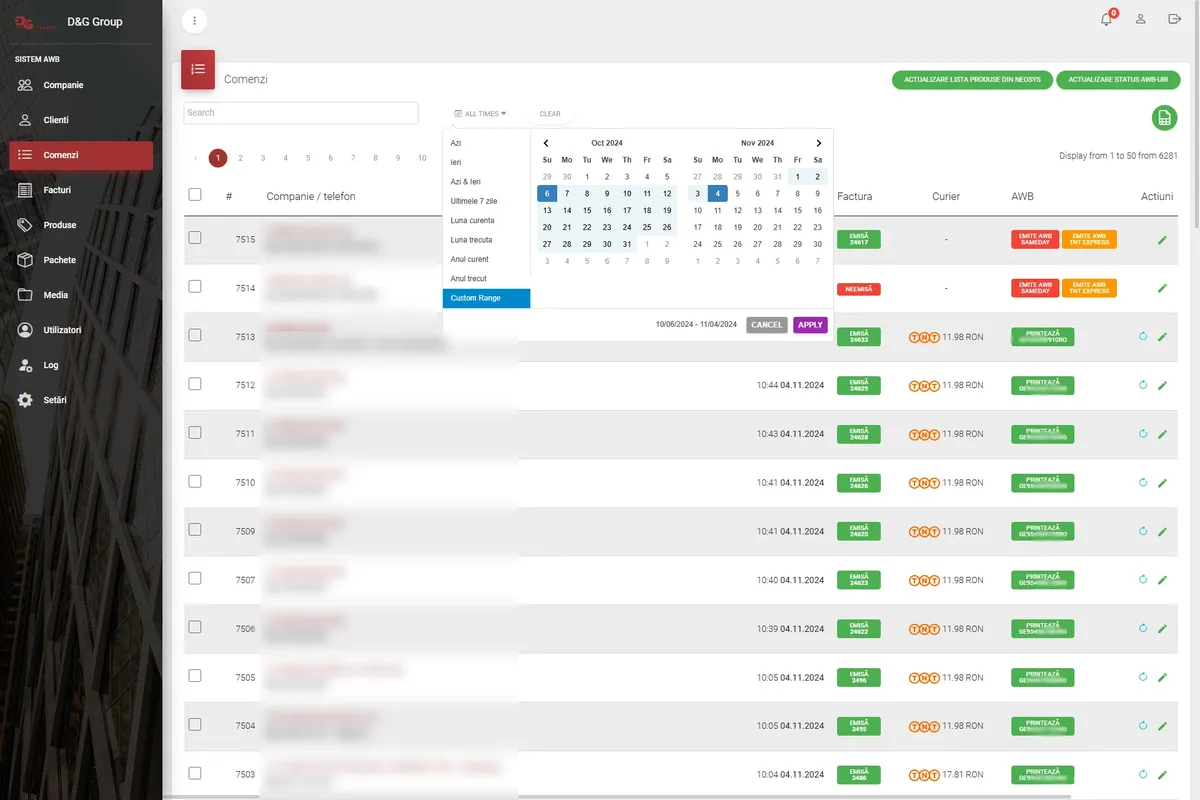
The AWB is issued from the order with the chosen courier, together with the shipping cost, and labels can be generated for every parcel. Statuses update with one button.

Example: Sameday and TNT Express at D&G Group.

Packages, weight and volume

For every package: name, code, quantity, weight and dimensions. The platform calculates the total weight and volume of the order automatically.

Example: packages in Time Critical Line orders.

Documents and invoices

Shipping documents (PDF) and pictures are attached to the order. Invoices are linked to orders, with series, due date and credit notes, and printed from the platform.

Example: invoices linked to orders at D&G Group.

Track & trace for your customers

Customers enter the AWB or package number on your website and see where their shipment is, without calling or sending an email.

Example: the “Track & trace” page on time-critical-line.com.

Customer notifications

Customers get an SMS when the order status changes. For each order, the team decides whether to notify on every status or only manually.

Example: SMS notifications at Time Critical Line.

Offices, roles and activity log

Offices, clients and couriers managed from the admin panel, users on permission levels and a log that shows who did what.

Example: up to 10 permission levels at Time Critical Line.

// other features we deliver

And the small features used every day

  • quotes exported to PDF or Excel, printed or emailed directly from the platform;
  • invoices issued directly from the platform, from the order data;
  • QR codes generated for products and orders;
  • notes on every shipment;
  • online chat between platform users;
  • reports in several formats and advanced search by multiple criteria.
// portfolio

Logistics and delivery platforms we have built

Three projects from our portfolio where transport and delivery are part of the application: a logistics company, a distributor and an online store. The full details are in the case studies.

The order status table in the Time Critical Line admin panel: flights between Budapest, Vienna, Frankfurt and Washington, with pieces, weights and planned and actual times
// logistics platform · road, air and sea freight

Time Critical Line: quoting, orders and shipment tracking

A web platform with an admin panel for a logistics company with more than 26 years in the business and offices in Romania, Hungary and Austria. We have been developing and maintaining it since 2020.

  • Flight statuses received through the Lufthansa Cargo and Qatar Airways Cargo APIs, with pieces and weights for every leg
  • Shipments declared in RO e-Transport and invoices sent to RO e-Factura, from the platform
  • Quotes generated from the order and sent to the customer automatically
  • Packages with total weight and volume calculated automatically, documents and pictures on the order
  • A public “Track & trace” page and SMS alerts when the status changes
Read the Time Critical Line case study
// how to choose

Custom logistics platform or off-the-shelf software?

Not every transport company needs a platform built from scratch. These are the differences that matter when you choose between subscription logistics software and a custom platform.

Comparison between subscription logistics software and a custom logistics platform
Criterion Off-the-shelf software (subscription) Custom platform
Workflow Your team adapts to the stages and fields of the software. The platform follows your flow: quote, order, shipment, delivery, invoice.
Integrations The ones the product offers, or through connectors. Built for your partners: airlines, couriers, your inventory software, SMS.
Your customers Tracking and notifications work the way the vendor designed them. The tracking page lives on your website, and notifications go out in your company's name.
Cost A monthly subscription that grows with your team and your modules. Development, then hosting and maintenance, agreed by contract.
Your data On the vendor's servers. On your server or in the cloud of your choice.
New features When the vendor adds them, for all its customers. When you need them, in the order of your priorities.

A custom platform makes sense if:

  • you handle several transport modes or multi-leg shipments that you want to track on the same order;
  • your team copies data between email, Excel, courier portals and the invoicing software;
  • customers call or write to find out where their shipment is;
  • you need integrations with airlines, couriers or your inventory software;
  • you want customer and shipment data to stay on your own server.
// for online stores

Shipping parcels from an online store?

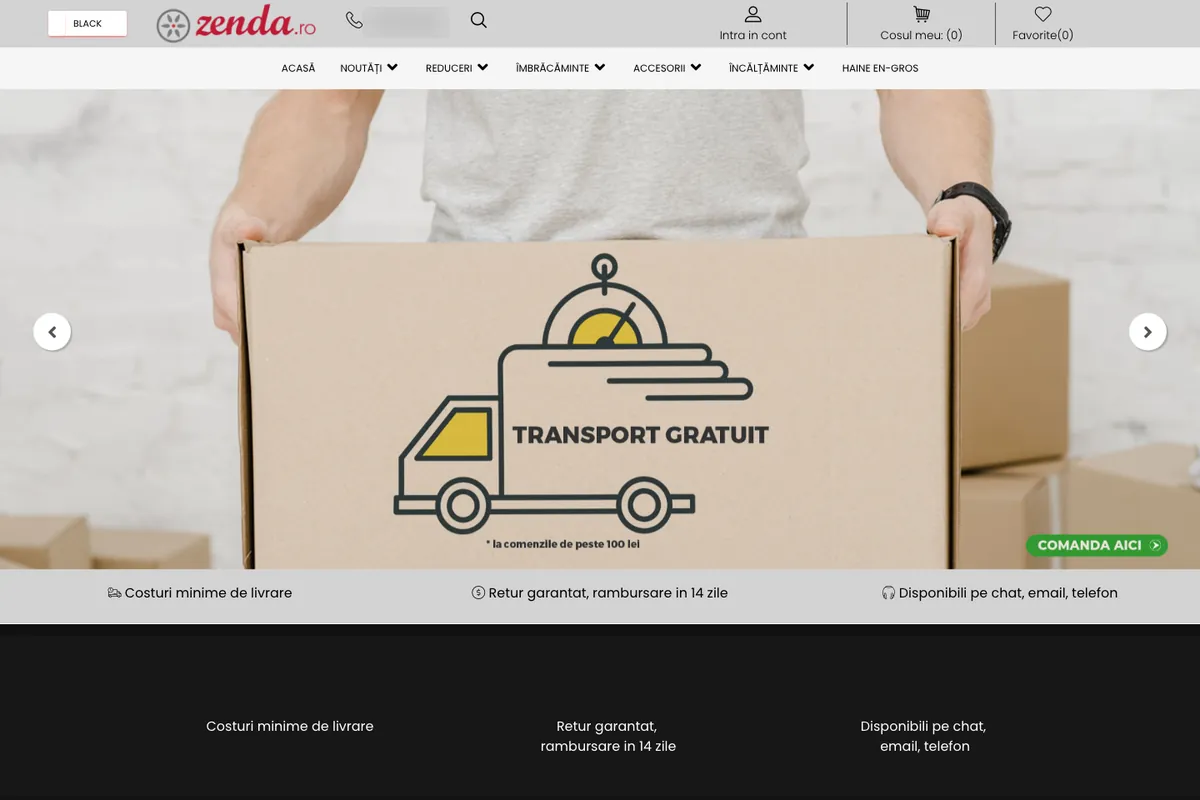
You may not need a separate platform. At Zenda, the store connects to courier companies through their APIs and picks the courier by itself, by region, customer type or cart value, while invoices are issued automatically.

Read the Zenda case study
// integrations

Integrations with airlines, couriers and inventory software

A logistics platform pays off when statuses, AWBs and invoices flow into it on their own, with no copying between applications. These are integrations we built in our projects.

  • Lufthansa Cargo API: flight statuses
  • Qatar Airways Cargo API
  • ANAF RO e-Transport: UIT codes
  • ANAF RO e-Factura
  • Sameday: AWBs
  • TNT Express: AWBs and labels
  • Courier APIs
  • Neosys: products
  • Saga: accounting
  • SMS notifications

Some of these are Romanian services (Sameday, Neosys, Saga, ANAF), but the approach is the same for any airline, courier or business software with an API: we review the documentation and the integration effort during the analysis. Existing data (customers, partners, order history) is imported from Excel or from your current application. See also the other integrations in the web applications we have delivered.

A mobile app for drivers and couriers

The platform runs in the browser on phones, tablets and desktops. If your field team needs an app installed on their phones, we build it on the same data, for Android or iOS.

Mobile app development
// ANAF · RO e-Transport

Shipments declared in RO e-Transport, from the platform

RO e-Transport is the Romanian tax authority (ANAF) system that monitors road transport of high fiscal-risk goods within Romania and international road transport of goods. Each shipment gets a UIT code that travels with the goods.

We connected our platforms to the ANAF SPV (the private online space for companies), with the company's digital certificate, through the ANAF eTransport API. Shipment data goes out from the platform or from an XLS, CSV or XML file, with no manual entry in the ANAF portal. The rules change often, so we check the current requirements during the analysis.

Used at Time Critical Line and Data Control.

// ANAF · RO e-Factura

Invoices issued in the platform and sent to RO e-Factura

The invoice is issued directly from the order data and reaches the ANAF SPV through the ANAF eFactura API, Romania's mandatory e-invoicing system, with no export and re-entry in another program.

Used at Time Critical Line and Data Control, and in eFacturia, the online invoicing software for which we are the technology partner.

// process

How we build a logistics platform

We start from the real path of a shipment through your company, not from a template. We work in stages, with demos along the way, so you see the platform grow and can adjust the direction early.

  1. 01

    Workflow analysis

    We talk to operations, sales and accounting: how a request moves from quote to delivery and invoice, who works in the platform and which systems it must talk to.

  2. 02

    Estimate and proposal

    You get a cost and time estimate, broken down by module. The proposal is free.

  3. 03

    Design

    Wireframes and design for the main screens (the order, the statuses, the tracking page), approved by you.

  4. 04

    Development in stages, with demos

    We build the platform module by module and show it to you along the way, not only at the end.

  5. 05

    Integrations, data import and testing

    We connect your partners' APIs, import your existing data and test the flows, roles and notifications before launch.

  6. 06

    Launch and training

    We put the platform into production and train the team that will use it.

  7. 07

    Maintenance and new modules

    Technical support, updates and new features as your company grows. We have been developing and maintaining the Time Critical Line platform since 2020, for example.

// budget and timeline

How much a logistics platform costs and how long it takes

We do not have a separate price for logistics software: a logistics platform is a custom web application or a custom ERP. A web application starts from €7,000 + VAT and usually takes 2–3 months. An ERP, which adds inventory, purchasing and invoicing, starts from €9,000 + VAT and takes 3–4 months. We estimate the final price by module, once we understand your workflow. These are the factors that matter most.

Workflows and modules

Quoting, orders, shipping, invoicing: how many stages and screens the platform has.

Users and roles

How many offices and user types there are, and what each one can see or approve.

Integrations

Airlines, couriers, inventory or invoicing software, SMS.

The customer side

The tracking page, notifications and, if needed, customer accounts.

Existing data

Importing from Excel or an old application, and how clean the data is.

Maintenance

Support, updates and new modules after launch.

We can start with the essential modules, such as orders and shipment tracking, and add the rest in stages while your team already works in the platform. Starting prices for every type of project are in our custom software pricing guide.

The proposal is free

After a first call, we send you a cost and time estimate. To make it as accurate as possible, tell us:

  • which transport modes and services you offer;
  • how an order moves today: quote, documents, statuses, invoice;
  • how many people will use the platform and which systems it must talk to.
Get an estimate
// questions

Frequently asked questions about logistics software

It is a web application built for one transport, freight forwarding or courier company, around its own workflow: quoting, orders, packages and documents, statuses, invoices and communication with customers. Unlike off-the-shelf software, the application adapts to the company, and the integrations are built for its partners: airlines, couriers, inventory software.

A logistics platform is a custom web application or a custom ERP. A web application starts from €7,000 + VAT, and an ERP with orders, inventory, purchasing and invoicing starts from €9,000 + VAT. The final price depends on the modules, the integrations and the data to migrate. The proposal is free. More in our pricing guide.

A web application with the core modules usually takes 2–3 months, and an ERP 3–4 months. Beyond that, it depends on the number of modules, the integrations and the data to migrate. The proposal includes a time estimate per module. We can launch the essential modules first, so your team works in the platform while we build the rest.

Yes. At Time Critical Line, flight statuses reach the platform through the Lufthansa Cargo and Qatar Airways Cargo APIs. At D&G Group, Sameday and TNT Express AWBs are issued from the order, and at Zenda the store picks the courier automatically, through APIs. For any other partner, we review the API documentation and the integration effort during the analysis.

Yes, for companies operating in Romania. We connected platforms to the ANAF SPV, with the company's digital certificate, through the ANAF eTransport and eFactura APIs: at Time Critical Line and Data Control. Data goes out from the platform or from an XLS, CSV or XML file. We are also the technology partner of eFacturia, an online invoicing software with RO e-Factura.

Yes. On time-critical-line.com, customers enter the AWB or package number and see where their shipment is, and they get an SMS when the status changes. The tracking page lives on your company's website, not on a software vendor's.

Yes. The platform is a responsive web application, so it runs in the browser on phones, tablets and desktops. If your drivers or couriers need an app installed on their phones, we can build it on the same data. See mobile app development.

Yes. Importing your existing data is part of the project: customers, partners and order history, once we agree on what to keep and how the fields map. The platform can also keep pulling data from another system, the way the D&G Group platform pulls its product catalogue from Neosys.

Ownership of and access to the source code are agreed by contract before development starts. We choose the hosting together, based on data volume and budget: your own server, a dedicated server or a cloud.

// technologies

What software technologies do we use?

Our main technology for web projects is Laravel, a PHP framework with elegant syntax that scales easily and offers excellent security.

Laravel doesn't stop us from working with .NET, Java, Swift or other technologies when a project calls for it. We prefer it for the web because it lets us deliver similar projects faster, at a lower development cost.

  • Artificial intelligence
  • Deep Learning
  • TensorFlow
  • .NET Framework
  • .NET Core
  • Java EE
  • Python
  • PHP
  • main Laravel
  • React
  • Vue.js
  • Bootstrap
  • REST API
  • Android
  • iOS
  • Swift
  • Jira
  • Git
  • GitHub
  • Bitbucket
  • SQL Server
  • MySQL
  • MariaDB
  • MongoDB
// next step

Do you have a project you want to develop?

Write to us or give us a call and we will set up a meeting. We reply with questions first, then with a free quote that covers cost and timeline.

Or email us at contact@devteam.ro.